some good submissions to the Hay(na)ku competition, but you still have 48 hours from the time of this post to outdo them.
Great prizes!
Great
way to
start the year.
Friday, December 30, 2005

Thursday, December 29, 2005
high/light of a time away
on
my back
on a banana
lounge,
looking up
at a night
sky
unencumbered by
any polluting light
my back
on a banana
lounge,
looking up
at a night
sky
unencumbered by
any polluting light
Home is
Bach on the CD player, & not having to justify why you're listening to that weird classical shit.
Friday, December 23, 2005
sea, sun - great things
Karri
Kokko's post
about the winter
solstice
& darkness
descending across the
(Fin)
land has
frightened me. So
I'm
shutting up
shop for a
couple
of days
& heading north,
Maybe
it'll be
a voyage of
dis-
covery. Maybe
only an excuse
for
a long
drive. Or maybe
it's
just the
old familiar familial
obligations.
Anyway, to
everyone, season's greetings.
Kokko's post
about the winter
solstice
& darkness
descending across the
(Fin)
land has
frightened me. So
I'm
shutting up
shop for a
couple
of days
& heading north,
Maybe
it'll be
a voyage of
dis-
covery. Maybe
only an excuse
for
a long
drive. Or maybe
it's
just the
old familiar familial
obligations.
Anyway, to
everyone, season's greetings.
Thursday, December 22, 2005
A Game of Chess
I was never a competent chess player, & haven't played for many, many years. But I've always been intrigued by the chess board, its numeracy – 4³ or 8² squares – the layout, the lines of fight, the moves.
Its construction carries with it an unlimited series of directions in which one can move, not necessarily linearly, think of the knights' moves, the act of castling. & if you fill those squares with words, randomly selected, then a set of conjunctions can be created, not necessarily meaningful, but often promising just that.
I've done a few visual poems along those lines. Filling up all the squares, not just those that the chess pieces initially occupy. The structure, the sameness of it, inhibits multiple outputs, so I've permitted myself only four over the past two years. Too many & the words, their combinations, would be over-whelmed by their surroundings, would become meaningless.
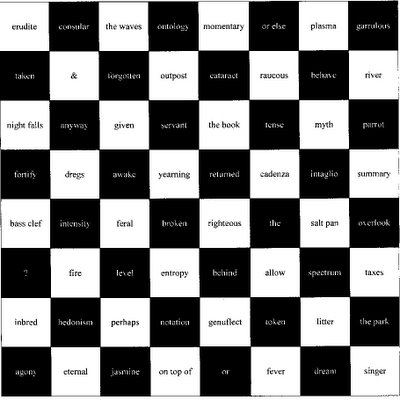
The first one, published in the New Zealand print journal brief was conceived as a homage to Marcel Duchamp, a great chess player, & named in honour of his The Bride Stripped Bare by her Bachelors, Even. The poem below, Erudite Singer, (click on the image to enlarge)appeared in Crag Hill's print journal Spore 2.0. Geof Huth generously wrote of it - &, as usual, succinctly nailed the concept:
Erudite Singer (2005)
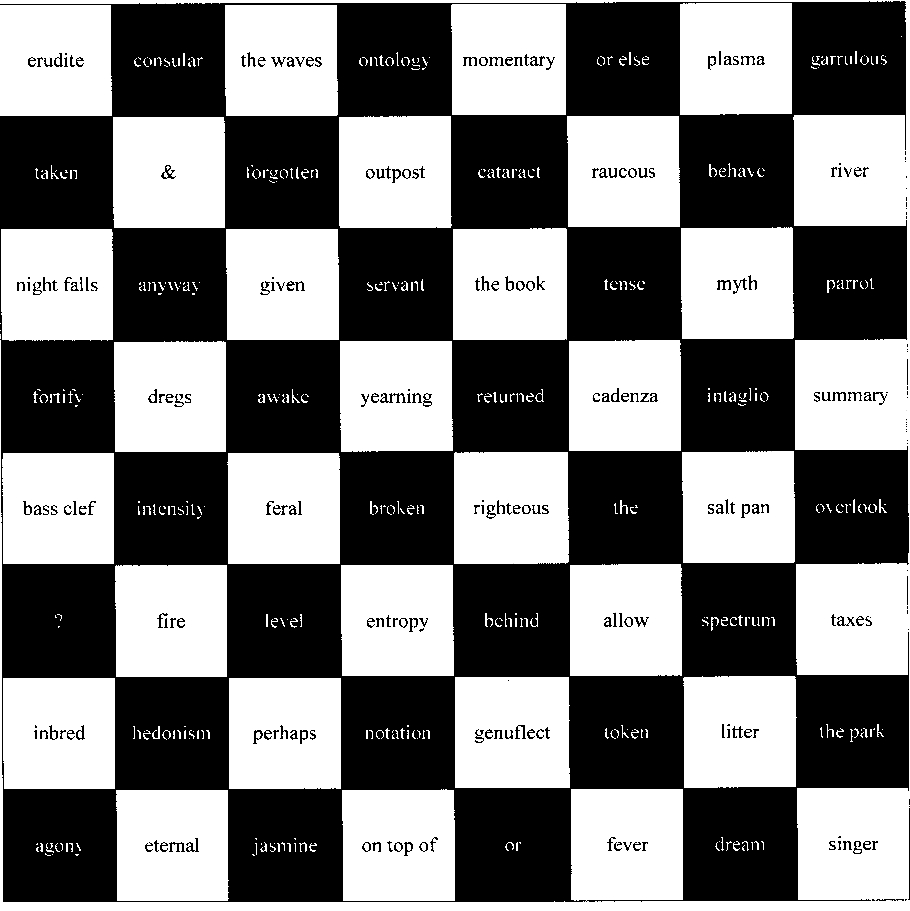
I have allowed myself only one variation, taking a point in a real chess game & placing the words in the positions they would be if they were the real pieces. I had the idea that it would be nice to track each of the moves as they occurred, but in a static setup, board by board, this would become boring, the proverbial watching paint dry. So I contented myself with just the original all squares filled in, & the progress report.
Marko Niemi came across a couple of the pieces I had in xStream, and, after translating them into Finnish, included them in the wonderful series of vispo that he has up here. But now he's gone further, & has produced a kinetic piece called Tzara vs Breton, 1921, inspired by my chess pieces, but with all the moves in.
Marko writes:
It's fantastic to see something you only ever thought about made real. Thank you for the piece, Marko, & thank you for dedicating it to me.
Its construction carries with it an unlimited series of directions in which one can move, not necessarily linearly, think of the knights' moves, the act of castling. & if you fill those squares with words, randomly selected, then a set of conjunctions can be created, not necessarily meaningful, but often promising just that.
I've done a few visual poems along those lines. Filling up all the squares, not just those that the chess pieces initially occupy. The structure, the sameness of it, inhibits multiple outputs, so I've permitted myself only four over the past two years. Too many & the words, their combinations, would be over-whelmed by their surroundings, would become meaningless.
The first one, published in the New Zealand print journal brief was conceived as a homage to Marcel Duchamp, a great chess player, & named in honour of his The Bride Stripped Bare by her Bachelors, Even. The poem below, Erudite Singer, (click on the image to enlarge)appeared in Crag Hill's print journal Spore 2.0. Geof Huth generously wrote of it - &, as usual, succinctly nailed the concept:
"Mark Young produces a simple visual poem entitled “Erudite Singer,” which consists of a checkerboard pattern of white and black squares covered with black and white words. The set up of the words encourages us to read the poem in multiple directions as we hunt for sense, for some linear syntax that we don’t quite find—every line of sense runs out before it gets far. But this pulsing network of whites and blacks, of words and shapes, ends up giving us a vague but palpable impression, and we are moved as we read from “erudite” in the upper left corner to “singer” in the bottom right corner."
I have allowed myself only one variation, taking a point in a real chess game & placing the words in the positions they would be if they were the real pieces. I had the idea that it would be nice to track each of the moves as they occurred, but in a static setup, board by board, this would become boring, the proverbial watching paint dry. So I contented myself with just the original all squares filled in, & the progress report.
Marko Niemi came across a couple of the pieces I had in xStream, and, after translating them into Finnish, included them in the wonderful series of vispo that he has up here. But now he's gone further, & has produced a kinetic piece called Tzara vs Breton, 1921, inspired by my chess pieces, but with all the moves in.
Marko writes:
" In fact, the Maori words are from a poem named "Toto-Vaca" by Tzara which can be found at http://www.artpool.hu/Poetry/ soundimage/Tzara.html. I didn't even know it's Maori, and also wondered how you were able to recognize the language, but then I made some googling and found out that Maori is (or at least has been?) spoken in New Zealand so I guess that might be the reason it looks familiar to you? A funny thing with it is that it somewhat resembles Finnish, for instance "te" means "you" (in plural) in Finnish, "he" means "they," and "kivi" means a "rock."I don't know if the Tzara piece is all Maori - &, by the way, New Zealand is now officially bilingual – since I don't recognise some of the words, but there's enough Maori words there to claim it as such.
The black Breton words are from his poem "Toutes les écolières ensemble" and its English translation. And the moves used in the pieces are from the first game of the first match between Deep Blue and Garry Kasparov, in 1996, the first ever game to be won by a computer against a world champion (although Kasparov eventually won the first match). "
It's fantastic to see something you only ever thought about made real. Thank you for the piece, Marko, & thank you for dedicating it to me.
Wednesday, December 21, 2005
For some reason or other
I've had the Ferlinghetti poem "Dada would have loved a day like this" running around in my head. Not just the poem as printed, but transformed as if it were one of Bill Allegrezza's kinetic pieces with the words fading in & out.
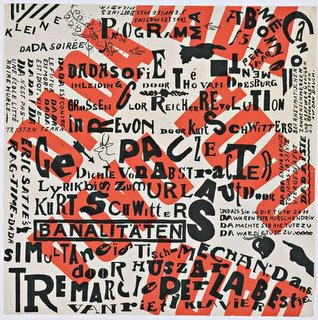
& since I don't know how to do those, I've compromised by deciding to post Kurt Schwitters' Kleine Dada Soirée.
& since I don't know how to do those, I've compromised by deciding to post Kurt Schwitters' Kleine Dada Soirée.

Yes Dada would have loved a day like this
with its not so accidental
analogies
Okay
so I know it's coming up to the, ahem, festive season, &, being generous souls, you're busy getting pressies - prezzies? - for everyone else. But why don't you do yourself a favour & get some for yourself, simply by writing a brilliant hay(na)ku & entering it in the hay(na)ku competition. Probably doesn't have to be brilliant even, just somewhere this side of good.
The prizes for the ten best are far, far better than those sox or handkerchiefs that your Great-Aunt Pulchritude is going to send you. &, I promise you, they won't have the lavender scent that comes from being stored in her drawers for the last ten years.
The prizes for the ten best are far, far better than those sox or handkerchiefs that your Great-Aunt Pulchritude is going to send you. &, I promise you, they won't have the lavender scent that comes from being stored in her drawers for the last ten years.
Freight

"…and the expensive delicate ship that must have seen
Something amazing, a boy falling out of the sky,
Had somewhere to get to and sailed calmly on."
W.H.Auden: Musée des Beaux Arts
(photo from TIME's best pictures of 2005)
Monday, December 19, 2005
I think
that one of the reasons I like crime stories so much - apart from the puzzle-solving aspect which I enjoy - is because, for each writer, the protagonist - I deliberately do not use the term hero or heroine - is usually the same person. You know what they're about already, don't have to work out the quirks of their character.
Saturday, December 17, 2005
A couple
of recent posts at chris murray's tex files, one on Andre Breton & one on Max Planck & the language of Quantum Mechanics, combined to prompt my memory of the poem at the bottom of this post, originally published in Blackmail Press #4, June, 2002.
I also received an email earlier on this year about the poem, part of which read:
I also received an email earlier on this year about the poem, part of which read:
"MoRST stands for the Ministry of Research, Science and Technology, which advises the (New Zealand) Government on policy issues across the science world.Unfortunately, I think the idea might have died, because I've heard no more about it apart from the fact that a couple of the authors were being difficult about granting permission. A pity.
The Ministry has recently refurbished its offices in the Reserve Bank Building at number 2, The Terrace, Wellington. A part of this refurbishment was the creation of five large meeting rooms, as the Ministry frequently hosts forums and workshops on science and research topics.
In seeking to find a name for each of these rooms, we have had a small team of staff sharing their favourite poems that use scientific terms and imagery. One of these is your poem Scar Tissue. We would like to display the poem, in full and as published, in one of the rooms and have selected the words NEUTRON FLUX, from the poem, as the room name. The door plate would state the name of the room and acknowledge the poem and you as the author."
Scar Tissue
We cannot leave emptiness alone,
even a space so small
it is beyond most common definitions.
Who knows the provocation for such
actions. Start large, & there’s
certainly ancestral memories —
agoraphobia controlled by
inventing animism, filling in the gaps
by ascribing godhood to everything
in sight & gods to everything beyond.
Start small, learning as schoolchildren
by seeing blood or pond water under
a microscope display such levels of
intricacy that we automatically allocate
to all such spaces, even those we
cannot see, an infinite number
of inhabitants. It used to be a metaphysical
conundrum, determining how many angels
danced on the point of a needle. Now
it’s called neutron flux & though we have
invented machines to measure it, still use
the language of Dada for description.
Phonoms, leptons, quarks & quasars —
these words were all originally Tzara’s.
the big Thor-oh?
in
vino veritas,
in flu enza
§
Delirious
with the
flu I think
thunder
= Thor-hammer,
coughing = Thor-ax.
§
Nothing
there I
could have Thor-saw.
vino veritas,
in flu enza
§
Delirious
with the
flu I think
thunder
= Thor-hammer,
coughing = Thor-ax.
§
Nothing
there I
could have Thor-saw.
Friday, December 16, 2005
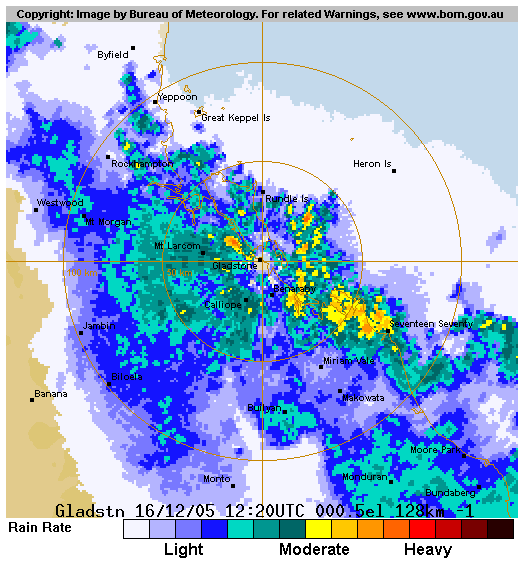
Thursday, December 15, 2005
Wednesday, December 14, 2005
Lorna Dee Cervantes
has a series of longish autobiographical posts up at her eponymous blog, recollections of her life 30, 20, 10, 5, 1 year ago.
They're absolutely brilliant. Open, emotion-provoking but not necessarily emotional though the pain (& the joy) comes through, precisely written, intense.
Wonderful writing.
They're absolutely brilliant. Open, emotion-provoking but not necessarily emotional though the pain (& the joy) comes through, precisely written, intense.
Wonderful writing.
Subscribe to:
Posts (Atom)